The status of the Universe: 2015
With
the full suite of observations of the Universe now at our disposal,
what is the story, contents, and history of the Universe?
“People are trapped in history and history is trapped in them.” -James A. Baldwin
For
as long as we’ve been looking at the skies, we’ve been using what we
see to learn about the Universe. As we collected a great suite of
observations, we learned about a vast variety of objects in the
Universe, including stars of many different types, masses, colors, and
variability,
 Image credit: NASA, ESA, and H. Richer (University of British Columbia).
galaxies in many different shapes, sizes and at a plethora of distances,

and
distant signals from the Universe that come from even earlier: a
background of microwave radiation that’s left over from the beginning of
our Universe itself.

What
we’ve been able to put together from all of this is a coherent picture
of how our Universe came to be: beginning from a hot, dense, expanding
state, the Universe cooled as it expanded, giving rise to matter, the
first atomic nuclei, neutral atoms, and then under the influence of
gravity, the first stars formed, and then galaxies and clusters formed
on large scales, separated by huge cosmic voids.

By
examining exactly what the structure of the Universe looks like today,
both nearby and far away, we can figure out what needed to happen in the
Universe in order to have it form the way it did. By looking at galaxy
distributions and maps, by looking at the distances and redshifts to
various objects — including quasars and supernovae — and by looking at
the distribution of everything we can see in the Universe from visible
light to X-rays to gravitational signals, we can determine exactly what
needs to be in the Universe today.

Similarly,
by looking at the fluctuations in the light patterns in the cosmic
microwave background — what we now know to be the leftover glow from the
Big Bang — we can determine those same parameters.

Among the things we can learn are the following:
- How old is the Universe?
- How big is the part of the Universe we can see?
- What is the shape of the Universe’s space?
- What makes it up, and in what amounts?
- What is the Universe’s fate?
- And where did the Universe come from?
The
two largest, most successful efforts to ever tackle these measurements,
the Sloan Digital Sky Survey (SDSS, for measuring galaxies) and the
Planck satellite (for measuring the imperfections and polarization of
the Cosmic Microwave Background) have just presented their latest
results, with more results coming from Planck in the coming weeks.


These represent the best measurements and the tightest constraints ever on the answers to these questions. First off, it’s important to know that the observations all point to the same exact answers, which we should just give you right now!
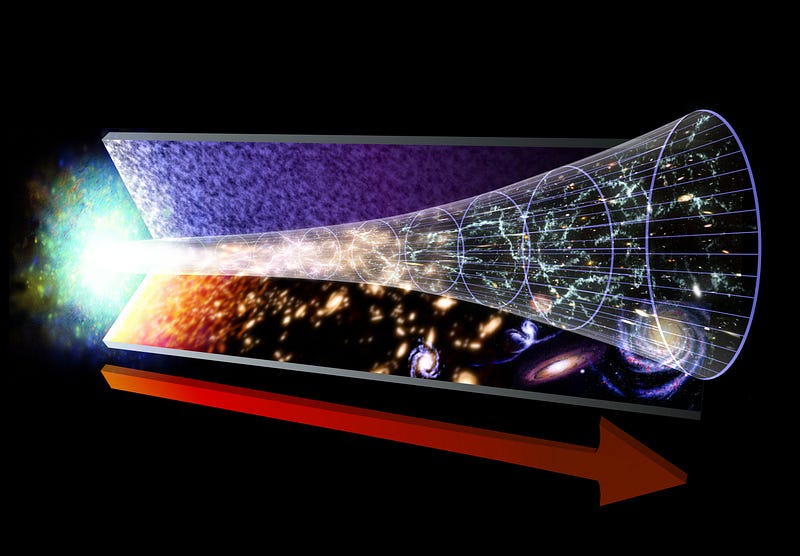
The Universe is 13.81 billion years old,
which is to say that’s the amount of time that has passed since the Big
Bang, and since our Universe could first be described by a hot, dense
expanding-and-cooling state. The uncertainty on this is tiny, at only
around 120 million years, meaning that we know the age of the Universe
to a 99.1% accuracy!
 Image credit: Wikimedia Commons users Frédéric MICHEL and Azcolvin429, annotated by me.
The part of the Universe we can see — our observable
Universe — is 46.1 billion light-years in radius, centered on us. The
uncertainty here is almost as small: 500 million light-years, which
means we know the (visible) Universe’s size to a 98.8% accuracy.

The
Universe could have been curved positively (like a sphere), negatively
(like a saddle), or it could be completely flat. We’re restricted to the
part we can see, but what we can determine is that if the Universe is
curved, the amount of curvature is no more than 0.25%.
(New constraint from Planck 2015!) This means that if the Universe is
actually a closed sphere or a saddle, the departure from “flatness” for
the part we can see is only one-in-500, which means the Universe is really, really flat.

We
know that normal matter — atoms, made up of protons, neutrons and
electrons — makes up a significant part of the Universe. But not all or even most of it! Instead, our Universe consists of the following components:
- 0.01% — Radiation (photons)
- 0.1% — Neutrinos (massive, but ~1 million times lighter than electrons)
- 4.9% — Normal matter, including planets, stars, galaxies, gas, dust, plasma, and black holes
- 27% — Dark matter, a type of matter that interacts gravitationally but is different from all the particles of the Standard Model
- 68% — Dark energy, which causes the expansion of the Universe to accelerate.
All
of this adds up to 100%, which is consistent with the curvature being
flat as well: more leads to positive curvature and less leads to
negative.

In
addition, we have confirmed that dark energy is consistent with a
cosmological constant to the best precision ever. We measure this with a
parameter, w, that is equal to -1.00 exactly for a cosmological constant. Thanks to Planck and SDSS combined, we now know w
= -1.00 ± 0.09, which is an incredible advance over only a few years
ago. Thanks to this, we know the fate of our Universe: every galaxy that
isn’t gravitationally bound to us will continue to expand from us at an
asymptotically accelerating rate. The Hubble rate of expansion will
asymptote to around 48 km/s/Mpc (with an uncertainty of about 2
km/s/Mpc), and as galaxies get farther away, they’ll recede faster and
faster. After a few tens of billions of years, there will be no galaxies
left in our visible Universe beyond our local group, which will have
merged together into a single galaxy: Milkdromeda.

And
finally, the Universe got its start from a period of cosmic inflation
that came before and set up the Big Bang. The Universe consisted only of
energy inherent to space itself, and expanded from an unknown size and
for an unspecified duration — our only limits are that it was at least 10^-24 meters in size and expanded for at least
10^-33 seconds, with no upper limit (could be infinite) on
either — until it ended, giving rise to the Big Bang and the hot, dense
expanding state we have today. The initial pattern of density
fluctuations, the seeds for all the galactic structure in our Universe,
and possibly gravitational waves (which there’s still no new word about) all owe their origin to this period of time.
 Image credit: SDSS.
After thousands of years of philosophizing about all of these questions, we now have physical answers
to them. This is what our Universe is, this is what it looks like, this
is what it’s made of, this is where it’s headed, and this is where it
all came from.
There’s still
plenty of additional science to be done, greater details to flesh out,
and greater precision to nail down our cosmic parameters to. Moreover,
there are incredible things we’re learning right now about
the nature of dark matter and why there’s more matter than antimatter
in the Universe, so we know there are tantalizing breakthroughs on the
horizon to work towards.
But
it’s always important to take stock of where we are, what we know, and
how far we’ve already come. Now, let’s take the steps to go a little
farther!

No comments:
Post a Comment